
In 2026, having an online presence is no longer optional for small businesses—it is essential. Customers are increasingly using Google, social media, online reviews, and AI-powered search tools to discover brands, compare products, and make purchasing decisions.
The good news is that small businesses do not need massive marketing budgets to compete online. With the right digital marketing strategies, businesses can increase brand visibility, attract qualified leads, build customer relationships, and drive sustainable growth.
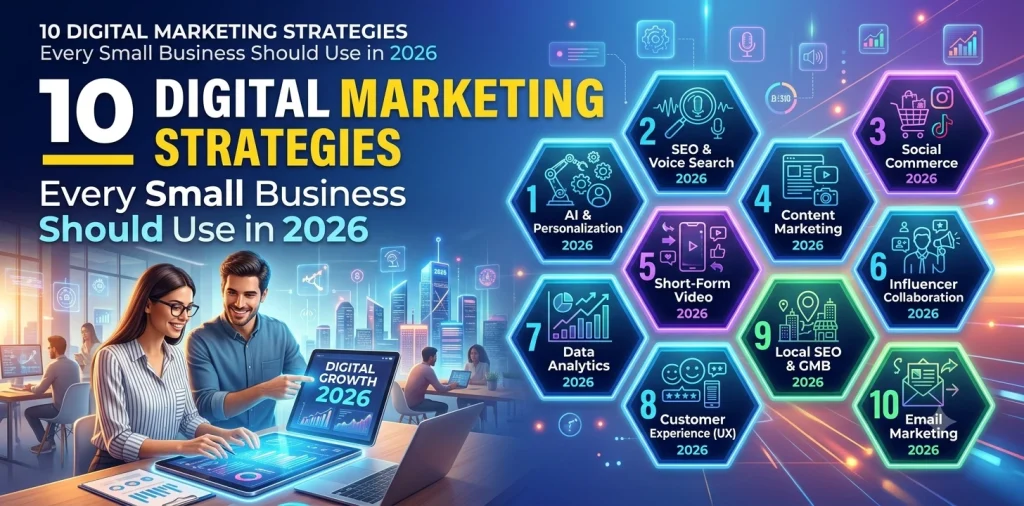
Whether you run a local store, service business, startup, or e-commerce brand, here are 10 digital marketing strategies every small business should use in 2026.
1. Build a Strong SEO Strategy
Search Engine Optimization (SEO) remains one of the most effective ways to attract organic traffic. A well-optimized website can help your business appear when potential customers search for products or services related to your industry.
In 2026, SEO goes beyond simply adding keywords to web pages. Businesses should focus on:
- Creating useful, original content
- Optimizing website speed and mobile experience
- Targeting relevant long-tail keywords
- Improving internal linking
- Optimizing title tags and meta descriptions
- Building trustworthy backlinks
- Creating content that directly answers search intent
For local businesses, local SEO is particularly important. Optimizing your Google Business Profile, collecting genuine customer reviews, and maintaining consistent business information can help improve visibility in local searches.
2. Focus on Local SEO
If your business serves a specific city or geographical area, local SEO for small businesses should be a major priority.
For example, instead of targeting only a broad keyword such as “digital marketing agency,” a business could target more specific searches such as “digital marketing agency in Pune.”
Create location-specific service pages, optimize your Google Business Profile, encourage customer reviews, and publish locally relevant content.
Local SEO helps businesses connect with customers who are actively searching for nearby products and services, making it an effective lead generation strategy.
3. Create High-Quality Content
Content marketing is another powerful way to build authority and attract potential customers.
Instead of constantly promoting your products or services, create content that solves your audience’s problems. This can include:
- Blog posts
- How-to guides
- Case studies
- Infographics
- Videos
- FAQs
- Industry insights
- Social media content
For example, a digital marketing agency could publish articles about SEO tips for small businesses, social media marketing, Google Ads, website optimization, and online lead generation.
High-quality content can attract organic traffic while also helping potential customers understand why they should choose your business.
4. Use Social Media Marketing Strategically
Social media marketing continues to be an important part of a successful digital marketing strategy.
However, businesses do not need to be active on every platform. Choose the channels where your target audience spends the most time.
Depending on your business, these may include Instagram, Facebook, LinkedIn, YouTube, or other relevant platforms.
Focus on creating a combination of:
- Educational content
- Short-form videos
- Customer testimonials
- Behind-the-scenes content
- Product demonstrations
- Industry tips
- User-generated content
The goal is not simply to collect followers. Effective social media marketing should help increase brand awareness, engagement, website traffic, and conversions.
5. Invest in Google Ads and Paid Advertising
While organic marketing takes time, pay-per-click advertising (PPC) can help businesses reach potential customers quickly.
Google Ads allows businesses to target people who are actively searching for specific products and services. Social media advertising can also help you reach audiences based on interests, demographics, behaviors, and online activity.
For small businesses, the key is to start with a controlled budget and continuously optimize campaigns.
Track metrics such as:
- Click-through rate (CTR)
- Cost per click (CPC)
- Conversion rate
- Cost per lead
- Return on ad spend (ROAS)
A well-managed Google Ads campaign can become an effective source of qualified leads.
6. Optimize Your Website for Conversions
Getting visitors to your website is only half the job. Your website also needs to turn visitors into leads or customers.
A conversion-optimized website should have:
- Clear calls to action
- Simple navigation
- Fast loading speeds
- Mobile-friendly design
- Easy-to-find contact information
- Trust signals and testimonials
- Clear service or product information
- Simple contact or inquiry forms
For example, instead of using a generic button that says “Click Here,” use action-oriented CTAs such as “Get a Free Consultation” or “Request a Quote.”
Even small website improvements can have a significant impact on conversion rates.
7. Use Email Marketing to Build Relationships
Email marketing remains a cost-effective strategy for small businesses because it allows brands to communicate directly with existing and potential customers.
Businesses can use email campaigns to share:
- Special offers
- New products
- Educational content
- Company updates
- Newsletters
- Personalized recommendations
Building an email list also gives businesses an audience they can communicate with without relying entirely on social media algorithms.
Use segmentation and personalization to make your emails more relevant and valuable to subscribers.
8. Embrace Short-Form Video Marketing
Video content is becoming increasingly important in digital marketing. Short-form videos can help small businesses capture attention and communicate their value quickly.
Platforms such as Instagram Reels and YouTube Shorts provide opportunities to reach new audiences.
Businesses can create videos such as:
- Quick tips
- Tutorials
- Product demonstrations
- Customer stories
- Frequently asked questions
- Behind-the-scenes videos
- Before-and-after transformations
You do not always need expensive equipment. A smartphone, good lighting, and useful content can be enough to start.
9. Use AI to Improve Marketing Efficiency
Artificial intelligence is transforming how businesses approach digital marketing in 2026.
Small businesses can use AI-powered tools to assist with tasks such as:
- Content ideation
- Keyword research
- Customer segmentation
- Data analysis
- Ad copy variations
- Social media planning
- Customer support
- Marketing automation
However, AI should support human creativity rather than completely replace it. Businesses should review AI-generated content, add original insights, maintain their brand voice, and prioritize accuracy and customer value.
Used correctly, AI in digital marketing can help small businesses save time and compete more effectively.
10. Track Analytics and Measure ROI
One of the biggest advantages of digital marketing is the ability to measure performance.
Tools such as Google Analytics and advertising dashboards can help businesses understand where their traffic, leads, and sales are coming from.
Track important digital marketing KPIs, including:
- Website traffic
- Organic search traffic
- Leads generated
- Conversion rate
- Customer acquisition cost
- Engagement rate
- Return on investment (ROI)
Regularly reviewing your data allows you to identify what is working and where your budget should be focused.
Final Thoughts
Digital marketing in 2026 is not about using every available platform or following every trend. It is about choosing the right strategies for your business and consistently delivering value to your target audience.
From SEO and local SEO to social media marketing, content marketing, Google Ads, email marketing, video, AI, and analytics, small businesses have more opportunities than ever to reach potential customers online.
The most successful businesses will be those that combine these strategies into a clear, measurable digital marketing plan and continuously improve based on customer behavior and performance data.
If you are a small business owner looking to increase your online visibility, generate more leads, and grow your brand, investing in a well-planned digital marketing strategy can be one of the smartest decisions you make in 2026.